
A garage door spring carries the full weight of your door every time it opens or closes. When a spring fails, the door can fall without warning, creating a serious safety hazard for anyone nearby. U.S. consumer product safety regulations are clear: repairs to spring assemblies, cables, and related hardware should be performed by a qualified service person because a weak or broken spring can allow a door to fall rapidly, causing serious injury or death.
This article explains why professional garage door spring service in Colorado Springs matters, what local conditions accelerate spring wear, how to recognize the warning signs of a failing spring, and what a qualified technician does during a proper service visit. You will also learn what the City of Colorado Springs and the Pikes Peak Regional Building Department expect from construction-related work on your property.
Key Takeaways
- Garage door springs operate under extreme tension and must only be serviced by a trained technician.
- Colorado Springs freeze-thaw cycles, high UV exposure, and altitude accelerate spring fatigue faster than in milder climates.
- U.S. safety regulations require garage doors to be properly balanced and auto-reverse mechanisms to be tested monthly.
- The City of Colorado Springs advises property owners to contact the Pikes Peak Regional Building Department before remodeling or development work to confirm permit requirements.
- Torsion and extension springs have different lifespans, load ratings, and replacement procedures.
- Professional spring service includes balancing, hardware inspection, and a full safety check—not just the spring swap.
- Scheduling preventive tune-ups extends spring life and reduces the risk of emergency failures.
Understanding the stakes is the first step toward protecting your household. The sections below walk through each factor in plain language so you can make an informed decision about your door.
Why Garage Door Spring Service in Colorado Springs Carries Higher Stakes Than Most Homeowners Expect
Garage door springs are not ordinary hardware. A standard torsion spring stores hundreds of foot-pounds of torque to counterbalance a door that can weigh 150 to 400 pounds. That stored energy does not disappear when a spring breaks—it releases instantly, which is why a snapped spring sounds like a gunshot and why the door can slam to the ground in under a second.
You might be wondering why Colorado Springs specifically raises the risk level. The answer is climate. At roughly 6,000 feet above sea level, the Pikes Peak region experiences temperature swings of 40 to 60 degrees Fahrenheit in a single day during spring and fall. Metal contracts in the cold and expands in the heat. Repeated thermal cycling causes microscopic stress fractures in the coil wire long before the spring visibly shows damage. Add intense UV radiation at altitude and the dry air that accelerates lubricant evaporation, and you have conditions that shorten a spring’s rated cycle life by a measurable margin.
Clay soils common in El Paso County also affect driveways and garage slabs. Frost heave can shift the floor level slightly, throwing the door out of alignment and placing uneven load on one spring. A door that looks fine from the outside may already be stressing its hardware asymmetrically.
Torsion vs. Extension Spring Service in Colorado Springs: Understanding the Difference
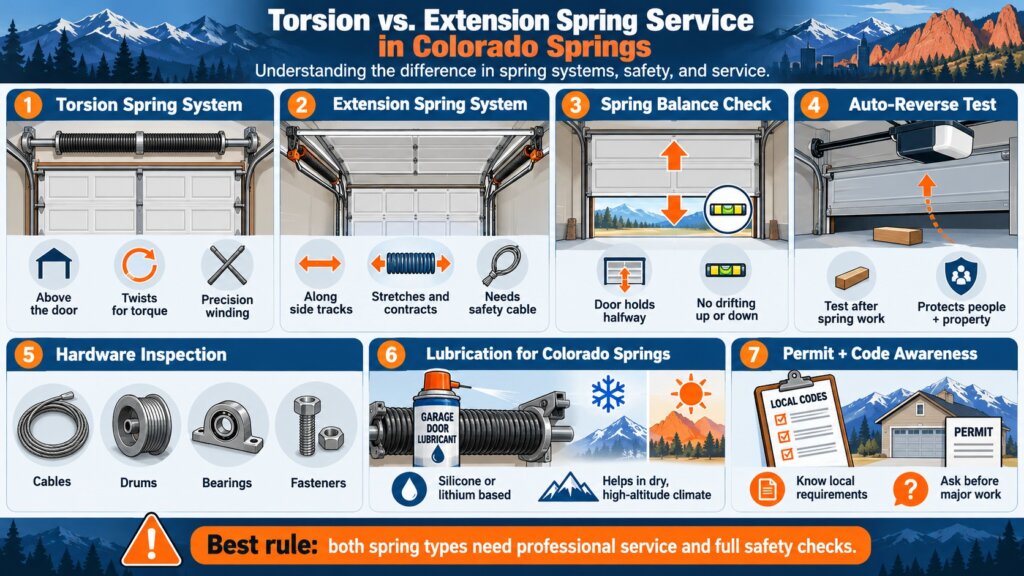
Knowing which spring system your door uses helps you understand what a technician is working with and why the service process differs between the two types. Both systems require professional handling, but the tools, adjustment methods, and safety precautions are distinct.
1. Torsion Spring Systems and Garage Door Spring Service Colorado Springs Technicians Perform
Torsion springs mount horizontally above the door opening on a steel shaft. They wind and unwind as the door moves, storing and releasing torque. A standard residential torsion spring is rated for 10,000 to 20,000 cycles. At two cycles per day, that equals roughly 14 to 27 years—but Colorado’s thermal stress can reduce effective life by 20 to 30 percent. Replacing a torsion spring requires a winding bar, precise torque calculations, and knowledge of the door’s weight and track geometry. Attempting this without training risks a violent uncontrolled release of the shaft assembly.
2. Extension Spring Systems and Garage Door Repair Colorado Springs Safety Checks
Extension springs run along the horizontal tracks on each side of the door. They stretch and contract rather than twist. These systems require safety cables threaded through the spring coils. If a spring snaps without a safety cable, the coil can become a projectile. During garage door repair in Colorado Springs, a qualified technician inspects both the spring and the cable, replacing worn components together rather than piecemeal.
3. Spring Balancing and Its Role in Garage Door Service Colorado Springs Residents Rely On
A balanced door stays in place when raised halfway and released. An unbalanced door drifts up or down, signaling that the spring tension does not match the door’s weight. Per U.S. consumer product safety guidance, proper balance is a regulatory requirement, not a preference. Technicians use a calibrated process: disconnect the opener, manually lift the door to waist height, and observe drift. Adjustment follows until the door holds position within a half-inch tolerance.
4. Opener Auto-Reverse Testing During Garage Door Spring Service Colorado Springs Visits
U.S. safety regulations recommend testing your garage door opener monthly to verify it reverses when it contacts a 1.5-inch object or a flat 2-by-4 board placed flat on the floor. A spring that is out of balance places extra load on the opener motor, which can degrade the auto-reverse sensitivity over time. During a professional service call, the technician tests the reversal force after completing spring work to confirm the opener responds correctly under the new load condition.
5. Hardware Inspection as Part of Comprehensive Garage Door Service Colorado Springs Homes Need
Springs do not fail in isolation. Cables fray, drums crack, and bearing plates wear in tandem with spring fatigue. A professional service visit covers the full hardware assembly: cables, drums, end bearings, center bearing, and fasteners. Replacing only the spring while leaving worn cables in place is a short-term fix that leads to a repeat failure within months.
6. Lubrication Specific to Colorado Springs Garage Door Spring Service Conditions
Standard petroleum-based lubricants thin out rapidly at high altitude and in low humidity. A technician selects a lithium-based or silicone-based lubricant rated for the temperature range your garage experiences—from below zero in January to above 90°F in July. Proper lubrication reduces coil-to-coil friction, which is one of the primary contributors to premature spring wear in the Pikes Peak region.
7. Permit and Code Awareness for Garage Door Spring Service Colorado Springs Properties
The City of Colorado Springs advises property owners to contact the Pikes Peak Regional Building Department before development or remodeling to determine whether a building permit is required. Construction-related businesses or services may require additional permits through that department. A qualified technician understands which scope of work triggers a permit requirement and can guide you through the process, keeping your project compliant from start to finish.
Warning Signs That Tell You Spring Service Cannot Wait
Recognizing early symptoms saves you from an emergency failure at the worst possible time—during a Colorado winter storm or on a weekday morning when you need to leave for work. The following signs indicate your springs need professional attention now.
- The door feels unusually heavy when you disconnect the opener and lift manually. A door in balance should feel nearly weightless at mid-lift.
- The door moves unevenly, with one side rising faster than the other. This points to unequal spring tension or a broken spring on one side.
- You hear a loud bang from the garage. A snapped torsion spring produces a sharp crack that echoes through the structure.
- The opener strains or slows during the lift cycle. The motor is compensating for lost spring assist, which accelerates motor wear.
- Visible gaps in the spring coil. A gap of one or more inches in the coil winding means the spring has broken and the door is running on the opener alone.
- The door does not stay open when raised manually. This is a direct balance failure and a safety hazard for anyone working beneath the door.
If you notice any of these signs, stop using the door and call a qualified technician. Continuing to operate a door with a compromised spring puts the opener, cables, and anyone in the garage at risk.
Comparing Spring Types: A Quick Reference for Colorado Springs Homeowners
The table below summarizes the key differences between torsion and extension spring systems to help you understand what your technician is working with during a service call.
| Feature | Torsion Spring | Extension Spring |
|---|---|---|
| Mounting location | Above door opening on a shaft | Along horizontal tracks, one per side |
| Typical cycle rating | 10,000–20,000 cycles | 8,000–15,000 cycles |
| Failure mode | Coil fractures; door drops | Spring snaps; projectile risk without safety cable |
| Adjustment method | Winding bar torque adjustment | Hook position change on track |
| Colorado Springs climate impact | High—thermal cycling stresses coil wire | High—stretch fatigue compounds with temperature swings |
| DIY suitability | Not recommended; high injury risk | Not recommended; projectile and cable hazards |
Both systems demand professional service. The difference lies in the specific tools and safety protocols each type requires, not in whether a homeowner can safely skip the technician.
What to Expect From a Professional Garage Door Spring Service in Colorado Springs
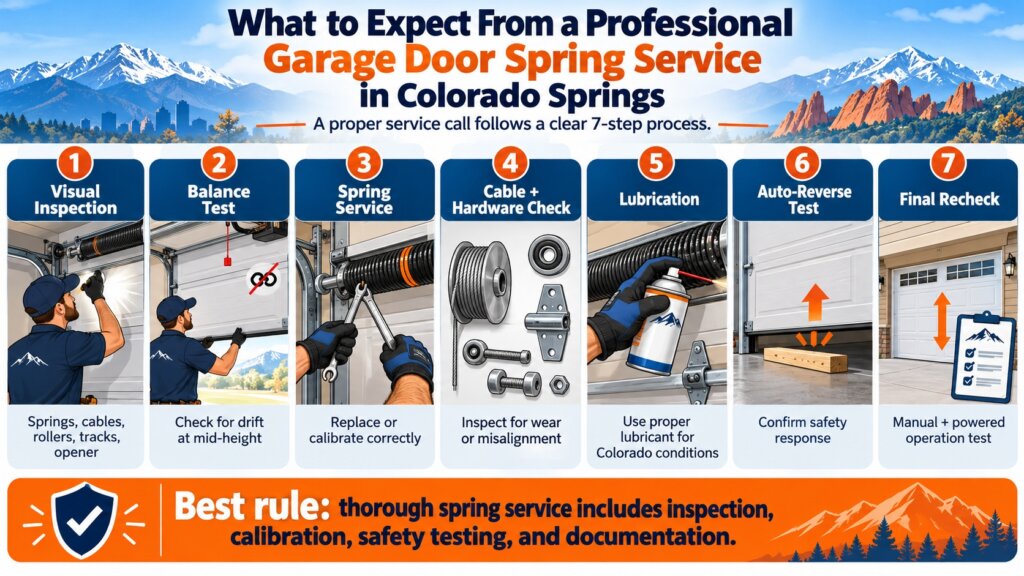
A well-structured service call follows a defined sequence. Knowing the steps helps you evaluate whether a technician is being thorough or cutting corners.
- Visual inspection: The technician examines the full door system—springs, cables, drums, rollers, tracks, and opener—before touching any hardware.
- Balance test: The opener is disconnected, and the door is lifted manually to mid-height to check for drift.
- Spring replacement or adjustment: Worn or broken springs are replaced with components matched to the door’s weight and cycle requirements. Adjustment follows calibration, not guesswork.
- Cable and hardware check: Cables, drums, and bearings are inspected for fraying, cracking, or misalignment. Worn parts are replaced during the same visit when possible.
- Lubrication: Springs, hinges, rollers, and tracks receive appropriate lubricant for Colorado’s altitude and temperature range.
- Auto-reverse test: A 2-by-4 board is placed flat under the door, and the opener is activated to confirm the reversal mechanism meets safety standards.
- Final balance recheck: The door is tested under power and manually to confirm smooth, even travel from fully closed to fully open.
Garage Door Colorado Springs follows this sequence on every spring service call. The company’s technicians use manufacturer-specified components and document findings so you have a clear record of what was inspected and replaced. If you need torsion or extension spring replacement, cable service, or a full preventive tune-up, scheduling with a locally operated team that knows El Paso County conditions means the work is done right the first time.
How Preventive Garage Door Spring Service Colorado Springs Homeowners Schedule Saves Money Long-Term
Emergency spring replacements cost more than planned ones. A spring that fails at 6 AM in January may require an urgent call, after-hours labor, and faster parts sourcing. A spring serviced on a routine schedule gets replaced during a standard appointment with standard pricing.
Preventive tune-ups also catch adjacent problems early. A cable that is 70 percent worn costs far less to replace during a scheduled visit than after it snaps and damages a drum or derails the door from its track. The same applies to rollers, hinges, and weather seals—all components that degrade in step with spring wear under Colorado’s climate conditions.
For homeowners in Briargate, Falcon, Monument, Fountain, Peyton, Manitou Springs, and Woodland Park, Garage Door Colorado Springs offers preventive tune-up appointments designed around the Pikes Peak region’s seasonal demands. A tune-up before winter and another before summer covers the two periods when thermal stress on springs is highest. Booking a Safety Tune-Up now costs a fraction of what an emergency call runs after a spring fails mid-winter.
Conclusion
Professional garage door spring service in Colorado Springs is not optional maintenance—it is a safety requirement backed by federal consumer product regulations and practical necessity given the region’s climate demands. Springs under high tension, combined with freeze-thaw cycles, UV exposure, and altitude, create conditions where DIY attempts carry real injury risk and where deferred service leads to costlier failures. Contact Garage Door Colorado Springs at 719-781-2350 or visit the office at 510 North Tejon Street, Suite 100, Colorado Springs, CO 80903 to schedule a spring inspection, request a quote, or book a full safety tune-up with a locally trained technician who knows your door, your neighborhood, and your climate.
Garage Door Colorado Springs specializes in precise torsion and extension spring replacement and balancing for local homes. Our certified technicians follow manufacturer specs and Colorado safety codes on every job. Contact us today to get started with honest, expert spring service built for Colorado Springs.
FAQs
How Much Does It Cost to Replace Garage Door Springs in Colorado Springs?
Most spring replacements in Colorado Springs typically range from about $200 to $500+, depending on whether you have torsion or extension springs, door size/weight, how many springs are replaced, and any related wear (cables, bearings, rollers). A precise quote requires confirming the correct spring size and balance to manufacturer specs.
How Long Do Garage Door Springs Last?
Most standard springs are rated for about 10,000 cycles (often around 7–12 years for many households), but lifespan depends on daily use, door weight, temperature swings, and maintenance. Higher-cycle springs and regular tune-ups can extend service life.
Can I Replace a Garage Door Spring Myself?
It’s not recommended. Springs are under extreme tension and improper handling can cause severe injury or property damage. Professional service ensures correct sizing, safe winding/tensioning, and full balance and safety checks for reliable operation.
How Do I Know If My Garage Door Spring Is Broken?
Common signs include a loud bang from the garage, the door suddenly feeling very heavy, the opener struggling or stopping, the door only lifting a few inches, or a visible gap in a torsion spring above the door. If you suspect a break, stop using the door and schedule an inspection.
How Long Does It Take to Replace Garage Door Springs?
In most cases, spring replacement takes about 45–90 minutes, including measuring, replacing components as needed, balancing the door, and performing safety tests. Complex setups or additional repairs can take longer.
