
A broken garage door cable in Colorado Springs is more than an inconvenience. It can leave your garage stuck open, your home exposed, and your door dangerously unbalanced. The short answer to whether you can still open your garage safely is: it depends on the damage, but in most cases, operating the door is not safe until the cable is professionally replaced.
This article walks you through what a broken garage door cable looks like, why it happens, what risks come with using a damaged door, and what steps you should take right now. You will also learn what to expect from a professional cable repair, how local Colorado Springs conditions affect cable wear, and when a full door inspection makes more sense than a single-part fix.
Key Takeaways
- A broken lift cable causes the door to sag, bind, or fall, making operation unsafe until repaired.
- ANSI guidelines state that cables, spring assemblies, and related hardware should be repaired only by qualified service personnel.
- Colorado Springs freeze-thaw cycles and UV exposure accelerate cable wear faster than in milder climates.
- OSHA enforcement records identify missing or failed safety devices on powered overhead doors as a struck-by hazard.
- Attempting to force a door open with a broken cable can cause the door panel to collapse or the spring system to release stored energy suddenly.
- Professional cable replacement typically restores full, balanced operation in a single service visit.
What a Broken Garage Door Cable in Colorado Springs Actually Means for Your Safety
Your garage door relies on two lift cables, one on each side, to transfer force from the spring system to the door. When one cable snaps or slips off its drum, the door loses balanced support on that side. The result is a door that tilts, jams in the track, or drops suddenly under its own weight.
You might be wondering whether the door is still usable with one cable intact. The answer is no. A single working cable places uneven stress on the drum, the spring, the track, and the bottom bracket. Each of those components can fail under that added load, turning a cable problem into a larger, more expensive repair.
According to a publicly available ANSI standards document, users should not go under a stopped or partially open garage door and should have qualified service personnel repair cables, spring assemblies, and related hardware. That guidance exists because the energy stored in a torsion or extension spring system is significant, and a cable failure changes how that energy is distributed across the door.
Common Causes of Broken Garage Door Cables in Colorado Springs
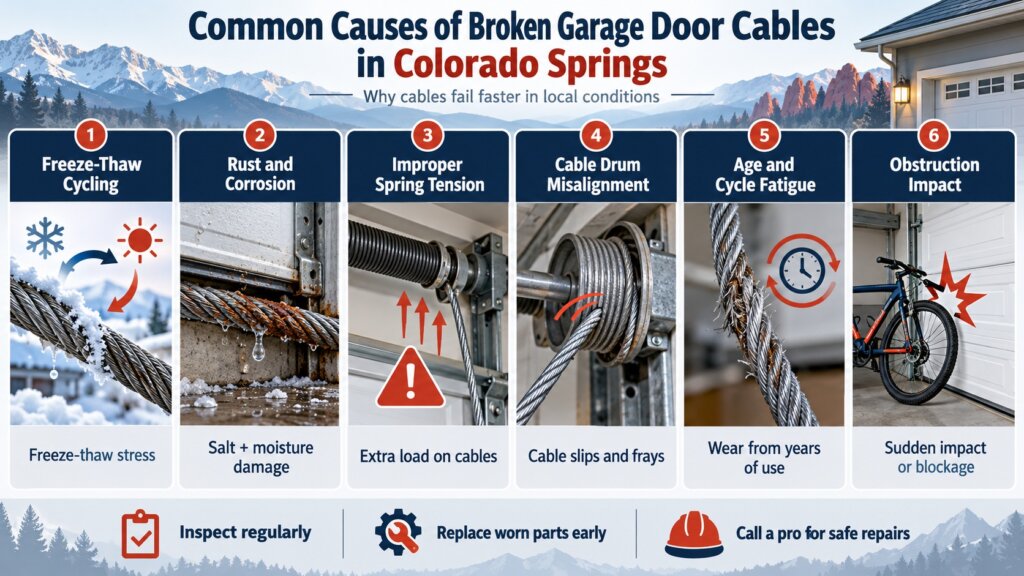
Understanding why cables break helps you prevent the next failure. Several factors are specific to the Colorado Springs environment, and they accelerate wear in ways that homeowners in other regions may not experience.
1. Freeze-Thaw Cycling
Colorado Springs temperatures can swing from below freezing overnight to above 50 degrees Fahrenheit the next afternoon. That repeated contraction and expansion stresses steel cable strands at the point where they wrap around the drum or attach to the bottom bracket. Over time, individual strands fray, and the cable eventually snaps.
2. Rust and Corrosion
Road salt tracked into the garage, combined with humidity from melting snow, creates a corrosive environment at the base of the door. The bottom cable attachment point is especially vulnerable. Rust weakens the cable from the inside out, so the failure often looks sudden even though it developed over months.
3. Improper Spring Tension
When a torsion or extension spring is set to the wrong tension, the cables carry more load than they were rated for. That overload shortens cable life significantly. A spring that is slightly out of adjustment may not be noticeable in daily use, but it quietly damages the cable with every cycle.
4. Cable Drum Misalignment
If the cable drum is not seated correctly on the torsion bar, the cable can slip out of its groove during operation. Once it rides off the drum edge, it frays against the drum housing or the track bracket. Misalignment is often caused by a previous repair that was not completed to manufacturer specifications.
5. Age and Cycle Fatigue
Standard residential lift cables are rated for a specific number of open-and-close cycles, typically matching the door’s spring rating. A two-car household that uses the garage four to six times per day can reach that limit in seven to ten years. High-altitude UV exposure in the Pikes Peak region also degrades the galvanized coating on cables faster than at lower elevations.
6. Obstruction Impact
A vehicle bumping the bottom panel, a child’s bicycle leaning against the door, or debris caught in the track can create a sudden load spike. That spike can snap a cable that was already near the end of its service life.
Can You Manually Open a Garage Door With a Broken Cable?
This is the question most homeowners ask first, and it deserves a direct answer. Manually lifting a door with a broken cable is physically possible in some cases, but it carries real risk of injury and further damage.
When one cable is broken, the door is no longer balanced. Lifting it manually puts all of that weight on one side of the frame and on your hands and back. If the spring system is still under tension, the door can move unpredictably once it clears the horizontal track. A door that weighs 150 to 300 pounds moving without controlled cable guidance can cause a serious crush injury.
The safer approach is to leave the door in its current position, disconnect the opener if it is still engaged, and contact a qualified technician. If the door is stuck in the open position and weather or security is a concern, a temporary barrier or call to a 24-hour repair service is a better option than forcing the door.
| Situation | Safe Action | Unsafe Action |
|---|---|---|
| Door stuck in closed position | Call a technician; use entry door | Force door open manually |
| Door stuck partially open | Do not pass under it; call for repair | Try to push it up or pull it down |
| Door stuck in open position | Secure the garage, schedule same-day service | Operate the opener to close the door |
| Cable visibly frayed but not broken | Schedule inspection before next use | Continue daily use until it snaps |
Now that you understand the immediate safety picture, it is worth looking at what a professional repair actually involves and what to expect from the process.
What a Professional Broken Garage Door Cable Repair Includes
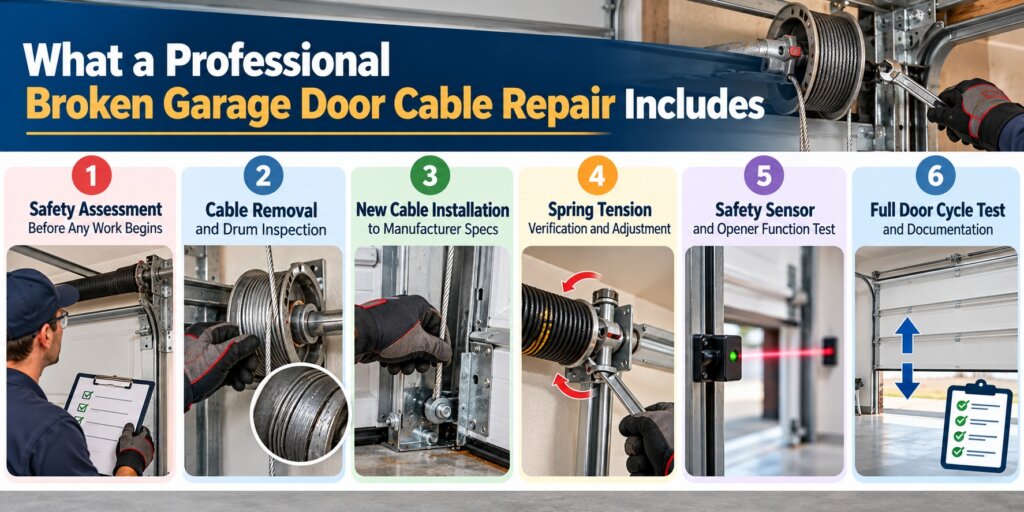
A qualified technician does more than swap the broken cable for a new one. A thorough repair addresses the conditions that caused the failure and checks the components most likely to be affected by it. Here is what a complete cable repair service typically covers.
1. Safety Assessment Before Any Work Begins
The technician inspects the spring system, drums, bottom brackets, and tracks before touching the cable. This step identifies whether stored spring tension needs to be released safely before the repair proceeds. It also catches secondary damage that a broken cable may have caused to the track or roller assembly.
2. Cable Removal and Drum Inspection
The old cable is removed from the bottom bracket and unwound from the drum. The drum is checked for wear grooves, cracks, and proper seating on the torsion bar. A damaged drum that is not replaced will shorten the life of the new cable.
3. New Cable Installation to Manufacturer Specifications
The replacement cable is rated to match the door’s weight and spring system. It is wound onto the drum at the correct number of turns and attached to the bottom bracket with the proper hardware. Cable gauge, length, and end fitting type all matter for safe, long-term performance.
4. Spring Tension Verification and Adjustment
After the cable is installed, the technician checks spring tension and adjusts it if needed. A door that is properly balanced requires minimal force to lift manually, typically less than ten pounds of effort at the midpoint. This balance test is a reliable indicator that the cable and spring system are working together correctly.
5. Safety Sensor and Opener Function Test
An OSHA enforcement record identifies missing safety edges or door-stop sensors on powered overhead garage doors as a struck-by hazard, referencing ANSI/UL 325 for recognized safety provisions. A complete repair includes testing the opener’s auto-reverse function and confirming that safety sensors are aligned and functional before the job is closed out.
6. Full Door Cycle Test and Documentation
The technician runs the door through several complete open-and-close cycles, listening and watching for binding, uneven movement, or unusual noise. Any issues found during this test are addressed before the technician leaves the property.
Garage Door Colorado Springs performs every cable replacement using this structured process. The company serves homeowners and light-commercial properties across Colorado Springs, El Paso County, Manitou Springs, Monument, Fountain, Falcon, Peyton, and Woodland Park. Every repair follows manufacturer specifications, local building codes, and a post-repair safety checklist. You can schedule service online or call the office at +1 719-781-2350 during business hours, Monday through Friday from 9 AM to 6 PM and Saturday from 9 AM to 4 PM.
How Colorado Springs Conditions Affect Cable Replacement Decisions
Local conditions shape which cable grade and coating make the most sense for your door. A technician familiar with the Pikes Peak region will factor in your garage’s exposure, your door’s cycle frequency, and the age of the spring system when recommending a replacement cable.
Galvanized steel cables offer corrosion resistance suitable for most Colorado Springs homes. For properties in areas with heavy road salt exposure or high moisture, a higher-grade galvanized or coated cable extends service life. On hillside driveways common in Manitou Springs and the Black Forest area, doors see more wind load and temperature variation, which can justify a heavier cable gauge than the minimum specification.
If your door is more than ten years old and has not had a full tune-up, a cable failure is often a signal that the spring system is also near the end of its rated cycle life. Replacing the cable without addressing a worn spring means the new cable may fail sooner than expected. A preventive tune-up that includes spring inspection, lubrication, and balance testing can identify those risks before they become emergency repairs. Garage Door Colorado Springs offers preventive tune-up services designed specifically for Colorado’s climate and the demands it places on door hardware.
When Cable Repair Leads to a Broader Garage Door Service Assessment
A broken cable is sometimes an isolated failure, but it is often part of a pattern. Several related components deserve attention at the same time to avoid repeat service calls.
- Bottom brackets: The bracket that anchors the cable to the door panel is under constant tension. Bent or cracked brackets should be replaced alongside the cable.
- Rollers: Worn or cracked rollers increase friction and place uneven side loads on the cable. Nylon rollers with sealed bearings last longer and reduce noise.
- Tracks: A cable that jumped the drum may have been caused by a track that is slightly out of plumb. Track alignment should be verified during any cable repair.
- Weather seals: If the technician is already at the door, checking the bottom seal and side seals for cracks or gaps takes only a few minutes and prevents heat loss and pest entry.
- Opener function: A door that has been operating with a compromised cable may have caused the opener to work harder than normal. Checking motor current draw and limit settings confirms the opener was not damaged in the process.
OSHA has noted that no specific federal OSHA standards apply exclusively to overhead doors, though general-industry standards may apply depending on the work context. That means the safety standards that do apply, including ANSI/UL 325 and NFPA 80, carry significant weight in defining what a compliant, safe installation and repair looks like. A repair company that follows those standards protects you and your property.
If the assessment reveals that the door itself is structurally compromised, or if the repair cost approaches the value of a new door, the technician can walk you through new door options that fit your budget and your home’s style. Garage Door Colorado Springs provides transparent, no-pressure quotes so you can make an informed decision without feeling rushed.
Conclusion
A broken garage door cable in Colorado Springs is a repair that needs professional attention before the door is used again. The risk of injury, further damage, and security exposure is real, and the fix is straightforward when handled by a qualified technician. Contact Garage Door Colorado Springs at +1 719-781-2350 or visit the office at 510 North Tejon Street, Suite 100, Colorado Springs, CO 80903 to schedule same-day cable repair or a full safety inspection.
Garage Door Colorado Springs specializes in cable, spring, and roller repair to restore safe operation fast. Our certified technicians serve Colorado Springs and surrounding El Paso County communities with code-compliant, honest fixes. Call us today to schedule your inspection—get started now.
FAQs
How Much Does It Cost to Fix a Broken Garage Door Cable in Colorado Springs?
Most cable repairs in Colorado Springs typically range from about $150 to $350, depending on door size/weight, cable type, whether drums or bottom brackets are damaged, and if a spring adjustment is needed. A precise quote requires an on-site safety inspection because cable failures often involve tension and alignment issues our technicians verify before replacing parts.
Can I Open My Garage Door If the Cable Is Broken?
It’s usually not safe. A broken cable can let the door lift unevenly, jam in the tracks, or drop suddenly—especially on heavier doors. If the door must be opened, stop using the opener, keep people and vehicles clear, and contact a professional to secure the door and correct the underlying balance and hardware issues.
What Causes Garage Door Cables to Snap?
Common causes include normal wear and corrosion, frayed strands from misaligned tracks or worn rollers, incorrect spring tension (an unbalanced door overloads cables), damaged drums, and impact damage. Regular tune-ups and balance checks help catch fraying and alignment problems before a failure.
How Long Does It Take to Replace Garage Door Cables?
In many cases, cable replacement takes about 60 to 120 minutes, assuming no additional damage. If the door is off-track, hardware is bent, or spring balancing is required, it can take longer to complete safely and to manufacturer specifications.
Do I Need to Replace Both Garage Door Cables If One Breaks?
Often, yes. Cables typically wear at a similar rate, so replacing both helps restore even lifting and reduces the chance of another failure soon after. If one cable is clearly newer and in excellent condition, a technician can confirm whether a single replacement is appropriate after inspecting wear, drum condition, and door balance.
