
Your garage door panels can crack even when nothing has hit them. This surprises many Colorado Springs homeowners, but the cause is almost always environmental stress combined with material fatigue. Colorado’s high altitude, intense UV exposure, and dramatic freeze-thaw cycles put constant pressure on panel materials year-round.
This guide explains exactly what causes panels to crack without an impact, how to identify the damage early, and when to call a professional for garage door panel repair in Colorado Springs. You will also learn which repair options make the most sense for your door type, your budget, and your long-term plans.
Key Takeaways
- Garage door panels crack without impact due to thermal expansion, UV degradation, moisture intrusion, and metal fatigue.
- Colorado Springs’ freeze-thaw cycles accelerate panel cracking faster than in lower-altitude regions.
- Steel, aluminum, wood, and fiberglass panels each respond differently to local climate stress.
- Early panel damage can compromise door balance, which poses a safety risk according to federal safety guidelines.
- Professional inspection is the safest way to determine whether panel repair or full replacement is the right call.
- Cracked panels left unaddressed can affect spring tension, cable alignment, and opener performance over time.
What Causes Garage Door Panels to Crack Without an Impact in Colorado Springs?
Panel cracking without a visible impact event is more common than most people expect. The damage builds gradually through repeated stress cycles rather than a single traumatic event. Once you understand the root causes, the cracks make complete sense.
Colorado Springs sits at roughly 6,035 feet above sea level. That elevation means stronger UV radiation, lower humidity, and more frequent temperature swings than cities at lower altitudes. These conditions wear down panel materials at an accelerated rate compared to places like Cincinnati or Minneapolis.
You might be wondering why your neighbor’s door looks fine while yours is cracking. The difference often comes down to panel material, door age, and how well the door has been maintained over the years.
1. Thermal Expansion and Contraction
Garage door materials expand and contract as temperatures change throughout the day. Repeated temperature fluctuations can place stress on joints, fasteners, coatings, and areas where panels are already weakened. Although temperature changes alone do not necessarily cause sound steel panels to crack, existing corrosion, manufacturing defects, or repeated mechanical strain can increase the likelihood of damage over time.
Those micro-fractures grow slowly. By the time you notice a visible crack, the structural integrity of the panel has already been weakened. Steel panels are particularly prone to this in areas with direct south or west sun exposure.
2. UV Radiation at High Altitude
Ultraviolet radiation generally becomes stronger as elevation increases because there is less atmosphere to absorb and scatter incoming UV rays. At roughly 6,000 feet above sea level, Colorado Springs experiences substantial UV exposure that can contribute to fading and deterioration of garage door coatings, fiberglass finishes, and some polymer components. The extent of damage depends on the panel material, protective coating, sun exposure, and maintenance history.
Once the surface coating fails, the base material becomes brittle. Fiberglass panels crack along the grain. Vinyl overlays on steel panels peel and allow moisture to reach the metal underneath. The result is surface cracking that looks cosmetic but often signals deeper structural stress.
3. Freeze-Thaw Moisture Cycles
Water expands by approximately nine percent when it freezes, creating pressure inside cracks, gaps, and porous materials. Colorado Springs experiences repeated freezing and thawing conditions throughout the colder months, although the frequency varies by year, location, and exposure. Moisture trapped within damaged coatings, wood fibers, or panel joints can contribute to further deterioration when temperatures fluctuate around freezing.
Wood panels are the most vulnerable to this process. Moisture absorption causes wood fibers to swell and shrink repeatedly, which splits the grain over time. Even steel panels with compromised paint can trap moisture at the panel edges and develop rust-driven cracking along the bottom rail.
4. Metal Fatigue From Repeated Door Cycles
A typical residential garage door opens and closes 1,500 to 2,000 times per year. Each cycle flexes the panel sections slightly as the door travels along the curved track. Over years of use, this repetitive bending creates fatigue stress at the hinge attachment points and panel corners.
You will often see this type of cracking appear near the hinges or along the horizontal panel joints. The crack pattern tends to be short and diagonal rather than long and straight. This is a structural signal, not just a cosmetic issue.
5. Improper Spring Balance Transferring Stress to Panels
Federal safety guidelines from the Consumer Product Safety Commission note that an improperly balanced residential garage door can cause severe injury and that qualified service personnel should handle cable, spring, and related hardware repairs. An out-of-balance door does not distribute weight evenly across the panel sections.
When one side carries more load than the other, the panels on the heavier side flex more during each cycle. That uneven stress concentrates at specific points and eventually produces cracking. If your door has cracked panels along one side more than the other, spring balance is worth checking immediately.
6. Poor-Quality or Aged Panel Materials
Not all garage door panels are built to the same standard. Lower-gauge steel panels, thin fiberglass skins, and untreated wood sections degrade faster under Colorado conditions. Doors installed more than 15 years ago may have been manufactured before current material standards were common.
Panel quality also varies by manufacturer. Panels rated for northern climates with wide temperature ranges tend to hold up better in Colorado Springs than panels designed for moderate coastal environments. Matching panel material to local climate is a key factor in long-term durability.
7. Clay Soil Movement and Garage Floor Shifting
El Paso County contains expansive clay soils that shift with moisture changes. When a garage floor or foundation shifts, the door frame can rack slightly out of square. A racked frame puts lateral stress on the bottom panel section and the track system.
This stress shows up as cracking near the bottom corners of the door or as a gap between the door and the floor on one side. If you notice your door no longer seals evenly at the bottom, soil movement may be contributing to panel stress.
Now that you understand the causes, the next step is knowing how to assess the damage and decide on the right repair path.
How to Assess Garage Door Panel Damage Before Calling for Repair
A visual inspection gives you useful information before a technician arrives. Knowing what you are looking at helps you describe the problem accurately and speeds up the diagnostic process. Keep the door closed during your inspection for safety.
| Damage Type | Likely Cause | Repair Priority |
|---|---|---|
| Surface hairline cracks | UV degradation or thermal stress | Moderate — monitor closely |
| Cracks near hinges | Metal fatigue or balance issue | High — affects structural integrity |
| Bottom panel splitting | Moisture, freeze-thaw, or soil shift | High — sealing and security risk |
| Corner cracking on one side | Racked frame or spring imbalance | High — requires balance check |
| Fiberglass delamination | UV and moisture combined | Moderate to high — cosmetic and structural |
| Wood grain splitting | Moisture absorption and freeze-thaw | High — accelerates quickly |
For an otherwise functional, undamaged garage door, homeowners should follow the opener manufacturer’s instructions for monthly safety-reversal testing. This commonly includes checking that the door reverses when contacting a 1.5-inch-high object or a 2×4 board laid flat on the floor. If the garage door has cracked structural panels, damaged cables, or visible alignment problems, stop using it and have the system inspected before performing operational tests
Never go under a stopped or partially open garage door when inspecting panel damage from inside the garage. Keep children away from the door and controls during any inspection or repair process, as federal safety guidance specifically warns against these situations.
With a clear picture of the damage, you can move forward and choose the right repair approach.
Garage Door Panel Repair Colorado Springs: Repair vs. Replace Options
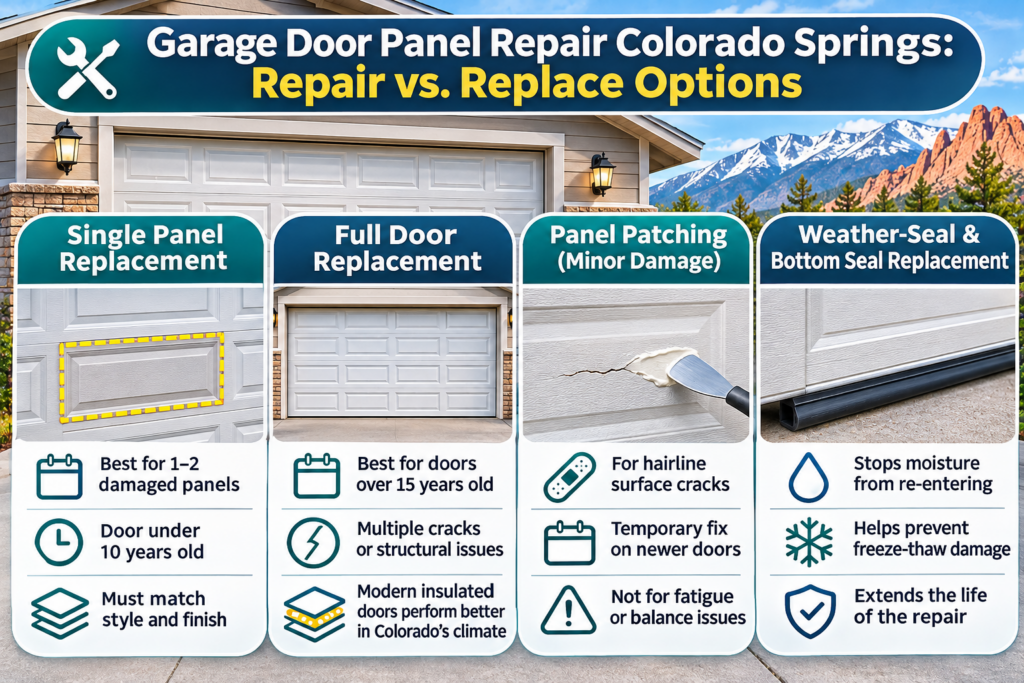
Deciding between repairing a single panel and replacing the full door depends on several factors. Panel age, damage extent, material availability, and door balance all play a role. Here is a breakdown of your main options.
Single Panel Replacement
Replacing an individual garage door panel can be cost-effective when the damage is localized and the remaining sections are structurally sound. The replacement must be compatible with the existing door’s manufacturer, model, dimensions, reinforcement, and hardware. Door age is an important consideration, but replacement panel availability, overall condition, and total repair cost ultimately determine whether replacing a section is practical.
Full Door Replacement
When a door is over 15 years old, has multiple cracked sections, or shows signs of structural imbalance, full replacement delivers better long-term value. Modern insulated steel doors rated for Colorado’s climate perform significantly better than older single-layer panels under freeze-thaw stress.
Garage Door Repairs Colorado Springs provides panel replacement and full door installation services across Colorado Springs, El Paso County, Monument, Falcon, Fountain, Peyton, Manitou Springs, and Woodland Park. Every job follows manufacturer specifications and local building codes, so your repair is done right the first time.
Panel Patching for Minor Surface Damage
Minor scratches, chipped paint, and superficial coating damage may sometimes be repaired with appropriate cleaning, surface preparation, and refinishing. However, cracks extending through a steel panel or affecting its structural reinforcement should not be treated as cosmetic damage. A professional inspection can determine whether localized refinishing is sufficient or whether the damaged section requires replacement.
Weather-Seal and Bottom Seal Replacement
Cracked bottom panels often coincide with failed weather seals. Replacing the bottom seal alongside the damaged panel prevents moisture from re-entering and slows future freeze-thaw damage. This is a straightforward add-on that extends the life of the repair.
What the City of Colorado Springs Requires for Garage Door Work
Understanding local permit requirements protects you from compliance issues down the road. The rules differ depending on the scope of work.
Garage door repair and replacement projects in Colorado Springs fall under applicable requirements administered by the Pikes Peak Regional Building Department. Routine repairs or like-for-like replacements may qualify for permit exemptions, while modifications affecting structural framing or the garage opening may require additional review. Homeowners should confirm project-specific requirements with the department before beginning work that involves structural changes.
The City of Colorado Springs directs property owners to consult the Pikes Peak Regional Building Department when remodeling work requires a building-related permit. Panel-for-panel replacement on an existing door typically does not require a permit. Full door replacement that involves structural changes to the opening may require one.
If you are a property manager overseeing multiple units in the Colorado Springs area, HUD’s NSPIRE inspection standard includes verifying that garage doors remain open without support and can be closed manually. Cracked panels that affect door balance or operation can create compliance issues during inspections.
Garage Door Repairs Colorado Springs operates under Colorado law and maintains professional standards for workmanship and code compliance on every job. If your project requires a permit review, the team can help you understand what documentation is needed before work begins.
Preventive Maintenance That Reduces Panel Cracking in Colorado Springs
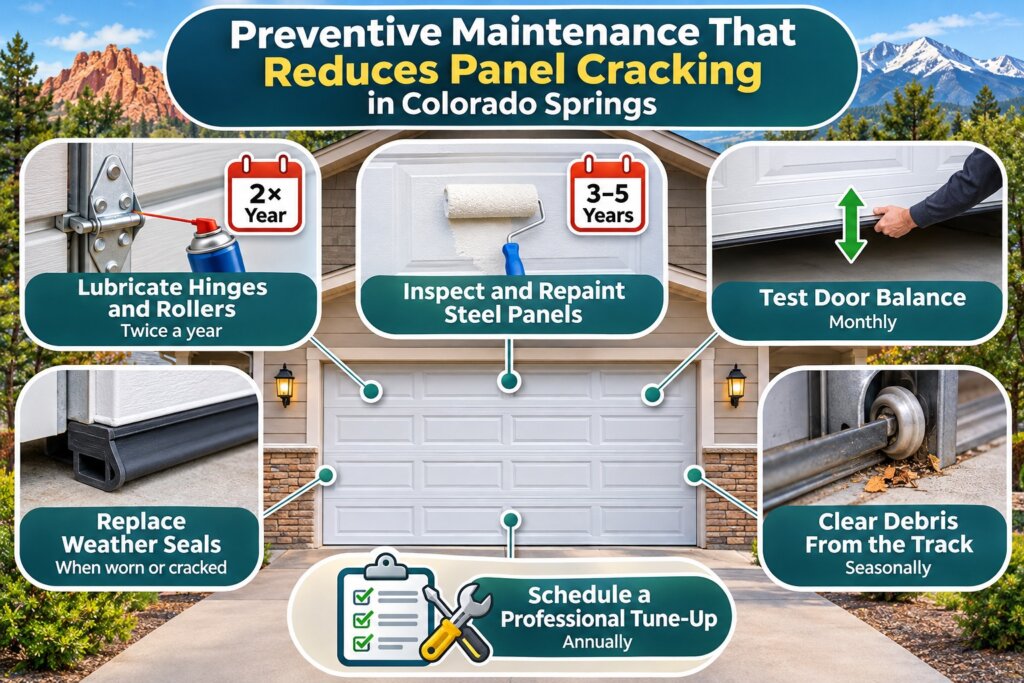
Prevention costs far less than repair. A consistent maintenance routine reduces the stress factors that cause panels to crack over time. These steps apply to all panel materials common in the Colorado Springs area.
- Lubricate hinges and rollers twice a year using a silicone-based or lithium-based lubricant. Dry hardware increases the stress transferred to panel edges during each door cycle.
- Inspect and repaint steel panels every three to five years. Intact paint protects against UV degradation and moisture intrusion at the panel surface.
- Test door balance monthly by disconnecting the opener and lifting the door manually to waist height. A balanced door stays in place. A door that falls or rises quickly needs a spring adjustment by a qualified technician.
- Watch for uneven door movement, unusual noises, gaps between sections, or difficulty opening and closing the door. If the door appears unbalanced or has visible structural damage, stop operating it and arrange a professional inspection. Do not adjust springs, cables, or other components under tension, as improper handling can cause serious injury.
- Clear debris from the track seasonally. Dirt and gravel in the track create uneven roller pressure that transfers stress to the panel joints.
- Schedule a professional tune-up annually to check spring tension, cable condition, hinge wear, and panel alignment before small issues become costly repairs.
Booking a seasonal tune-up with Garage Door Repairs Colorado Springs is one of the most practical ways to catch panel stress early. The team performs a full safety check, tests opener reversal function per federal guidelines, and identifies any balance or alignment issues that could accelerate panel damage.
Conclusion
Garage door panels can develop cracks without an obvious impact because of material deterioration, repeated mechanical stress, moisture intrusion, and underlying alignment problems. Colorado Springs’ temperature fluctuations and high-altitude sunlight may contribute to these conditions, depending on the panel material and maintenance history. Identifying the cause early helps homeowners determine whether panel repair or replacement is necessary.
Garage Door Repairs Colorado Springs provides professional panel inspections, garage door repairs, and replacement services throughout Colorado Springs and surrounding communities. Our technicians can assess visible damage, examine related hardware, and recommend appropriate repair options. Call 719-781-2350 to schedule an inspection or request an estimate.
FAQs
How Much Does It Cost to Repair a Garage Door Panel in Colorado Springs?
Costs vary by door type, panel material, and damage severity, but many panel repairs or partial fixes fall in the low hundreds, while full panel replacement (parts and labor) often ranges from a few hundred to over $1,000+ for premium or insulated doors. We provide an on-site estimate after confirming the door model, panel availability, and whether the door is still structurally sound and properly balanced.
Can a Single Garage Door Panel Be Replaced or Does the Whole Door Need Replacing?
A single panel can often be replaced if the manufacturer still makes the panel, the door isn’t discontinued, and the remaining sections, hinges, and tracks are in good shape. If the door is older, multiple sections are weakened, or matching panels aren’t available, replacing the full door can be more reliable and cost-effective.
How Long Does Garage Door Panel Repair Take?
Many repairs can be completed in about 1–3 hours if parts are available and the tracks and hardware aren’t compromised. If a special-order panel is needed, the on-site work is still typically a few hours once the part arrives.
Is It Safe to Operate a Garage Door With a Damaged Panel?
It may be unsafe because a cracked or bent panel can cause the door to bind, come off track, strain the opener, or fail under tension. If the panel is visibly cracked, bowing, or affecting alignment, it’s best to stop using the door and schedule an inspection to prevent further damage or injury.
Who Offers Same-Day Garage Door Panel Repair in Colorado Springs?
Garage Door Repairs Colorado Springs offers same-day service when scheduling and parts availability allow, serving Colorado Springs and surrounding areas like El Paso County, Manitou Springs, Monument, Fountain, Falcon, Peyton, and Woodland Park.
