
If your garage door springs break more than once every few years, you are likely paying more in repairs than necessary. High cycle garage door springs are built to last significantly longer than standard springs, and for Colorado Springs homeowners dealing with freeze-thaw cycles, high winds, and dramatic temperature swings, that durability matters. The question is whether the higher upfront cost is actually worth it for your specific situation.
This article breaks down exactly what high cycle springs are, how they compare to standard options, and what local climate conditions mean for spring longevity in the Pikes Peak region. You will also find a side-by-side comparison table, a breakdown of key benefits, and guidance on when upgrading makes financial sense—so you can make a confident, informed decision before spending a dollar.
Key Takeaways
- High cycle garage door springs are rated for 25,000–100,000 cycles compared to the standard 10,000-cycle rating.
- Colorado Springs weather—including freeze-thaw cycles and high-altitude wind gusts—accelerates spring wear faster than in milder climates.
- Upgrading to high cycle springs reduces the frequency of garage spring repair calls over the life of the door.
- The National Weather Service documents significant wind and temperature variation in the Colorado Springs area, both of which stress spring metal over time.
- High cycle springs are not always necessary for every home, but they are a strong fit for high-use households and commercial properties.
- Professional installation is required for torsion spring systems due to the extreme tension involved.
Understanding the basics of spring ratings helps you evaluate whether an upgrade fits your household. From there, local climate data gives the comparison real-world weight.
What High Cycle Garage Door Springs Colorado Springs Homeowners Should Know First
A standard garage door torsion spring is rated for approximately 10,000 cycles. One cycle equals one full open-and-close movement of the door. If a household uses the garage door four times per day, a standard spring lasts roughly seven years under ideal conditions—but Colorado Springs conditions are rarely ideal.
High cycle springs are manufactured with tighter wire tolerances and higher-grade steel, allowing ratings of 25,000, 50,000, or even 100,000 cycles. That translates to 17 to 68 years at four daily uses, though real-world factors reduce those numbers. The core advantage is fewer replacements, less downtime, and reduced long-term cost.
You might be wondering how much more these springs cost upfront. Depending on the spring size and cycle rating, high cycle options typically run 20–60% more than standard springs at the parts level. When factoring in the reduced frequency of garage spring repair service calls, most homeowners recover that difference within the first replacement cycle they avoid.
How Colorado Springs Weather Affects Garage Door Spring Lifespan
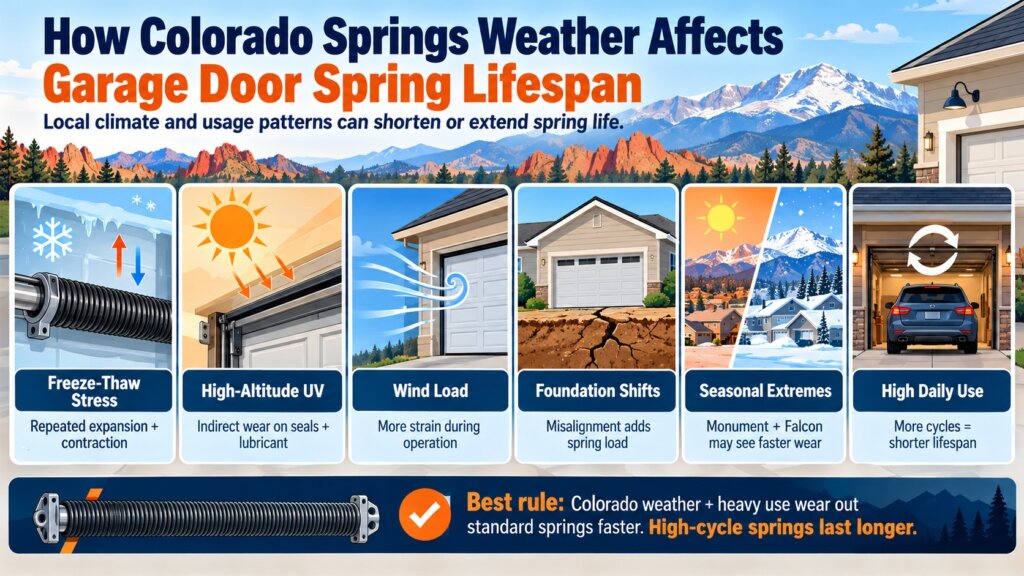
Local climate conditions directly impact how long any garage door spring lasts. The National Weather Service maintains official climate summaries for Colorado Springs and southern El Paso County, and those records show substantial seasonal temperature variation, measurable wind speeds, and freeze-thaw cycles that repeat throughout the year. Metal under repeated thermal stress fatigues faster than metal in stable conditions.
According to National Weather Service data for the Colorado Springs vicinity, wind gusts in the region can be significant, and temperature swings between day and night—especially in spring and fall—are pronounced at this elevation. Each temperature cycle causes the spring coil to expand and contract slightly. Over thousands of repetitions, that micro-movement contributes to metal fatigue.
Freeze-thaw cycles are particularly relevant for garage springs because lubricants thin out or congeal depending on temperature. A spring operating with inadequate lubrication under load experiences more friction and wear per cycle. High cycle springs, with their denser wire winding, handle this stress more reliably than standard coils.
1. Freeze-Thaw Stress on Spring Coils
Colorado Springs averages over 160 freeze-thaw events per year in some seasons. Each cycle stresses the spring metal at the molecular level. Standard springs show fatigue cracks sooner under these conditions than high cycle alternatives.
2. High-Altitude UV Exposure on Surrounding Components
At roughly 6,035 feet elevation, UV radiation is more intense than at sea level. While UV does not directly damage steel springs, it degrades rubber seals and lubricant films that protect spring hardware, indirectly accelerating wear.
3. Wind Load on the Door Panel
The National Weather Service records wind gust measurements for the Colorado Springs area that can place added mechanical stress on the door system during operation. A door fighting wind resistance puts more load on the spring with every cycle.
4. Clay Soil and Foundation Shifts in El Paso County
Expansive clay soils common across El Paso County can cause subtle shifts in garage framing. Even minor misalignment increases the load a spring must carry, shortening its effective life regardless of cycle rating.
5. Seasonal Temperature Extremes in Monument and Falcon
Communities like Monument and Falcon sit at higher elevations or in exposed terrain where temperature extremes are more pronounced. Homeowners in these areas tend to see faster spring wear than those in lower-elevation neighborhoods closer to downtown.
6. High-Use Households With Multiple Drivers
A household with two or three drivers using the garage as the primary entry point may log six to ten cycles per day. At that rate, a 10,000-cycle standard spring lasts fewer than five years. A 50,000-cycle high cycle spring extends that to 14–23 years under the same usage pattern.
With these local factors in mind, the comparison between standard and high cycle springs becomes more concrete. The table below puts the key differences side by side.
Standard vs. High Cycle Garage Door Springs: A Direct Comparison
Choosing between standard and high cycle garage door springs depends on how frequently you use your garage door, your budget, and your long-term maintenance goals. Standard springs generally have a lower upfront cost, while high cycle springs are designed to withstand more opening and closing cycles before replacement becomes necessary. Understanding these differences can help Colorado Springs homeowners select the right spring system for their needs.
| Feature | Standard Spring (10,000 Cycles) | High Cycle Spring (25,000–100,000 Cycles) |
|---|---|---|
| Expected Lifespan (4 cycles/day) | Approximately 7 years | Approximately 17–68 years |
| Upfront Parts Cost | Lower | Typically higher |
| Long-Term Repair Frequency | More frequent replacement | Less frequent replacement |
| Performance in Freeze-Thaw Conditions | Depends on material and maintenance | Depends on material and maintenance |
| Best Fit | Low-use homes, short-term ownership | High-use homes, long-term ownership, commercial properties |
| Wire Gauge / Steel Grade | Standard specifications | Engineered for greater cycle life; specifications vary |
High cycle garage door springs can offer better long-term value for homeowners who frequently open and close their garage doors and plan to remain in their properties for several years. Although standard springs may be sufficient for garages with limited daily use, high cycle options can reduce replacement frequency and associated service costs over time. Garage Door Repair Colorado Springs can help homeowners evaluate their garage door systems and choose appropriate springs based on usage, door weight, and maintenance requirements.
When High Cycle Garage Door Springs in Colorado Springs Are Worth the Investment
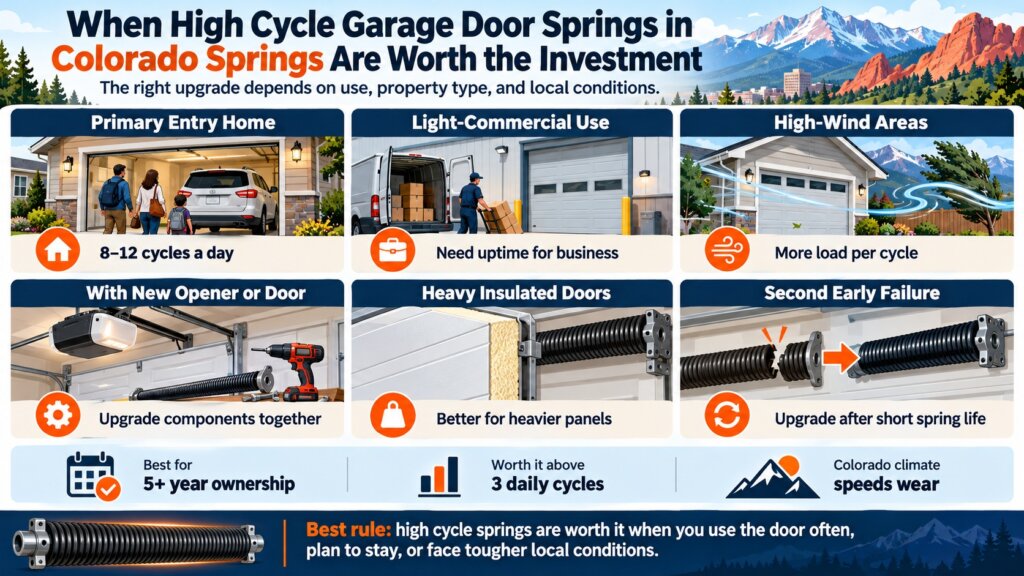
Not every homeowner needs the highest-rated spring available. The decision comes down to three factors: usage frequency, ownership timeline, and local exposure conditions. Matching the right spring to your situation is more important than always choosing the most expensive option.
You might be wondering where the break-even point is. In most cases, if you plan to stay in your home for more than five years and use the garage door more than three times daily, high cycle springs pay for themselves by eliminating at least one full replacement service call. In Colorado Springs, where climate conditions accelerate wear, that break-even point arrives sooner than in milder regions.
1. Primary Entry Point for the Home
When the garage is the main way in and out of the house, daily cycle counts climb fast. A family of four can easily hit eight to twelve cycles per day, making a high cycle spring the practical choice.
2. Light-Commercial Properties in Monument or Fountain
Small business owners operating bay doors for deliveries, auto service, or storage need maximum uptime. A broken spring during business hours creates real operational and security problems. High cycle springs reduce that risk significantly.
3. Properties in High-Wind Exposure Zones
Homes on hillside drives, open lots in Falcon or Peyton, or properties near the Front Range foothills face more wind load per cycle. Higher cycle-rated springs handle that added mechanical stress better over time.
4. Paired With a New Garage Door Opener Installation
If you are already investing in a smart garage door opener or a full door replacement, upgrading the springs at the same time maximizes the value of the service visit and ensures all components are rated for the same long-term performance window.
5. Homes With Heavy Insulated Doors
Insulated steel doors weigh more than single-layer panels. Heavier doors place more load on springs with every cycle. High cycle springs with heavier wire gauges are better matched to the demands of insulated door systems.
6. Second Replacement After a Short Interval
If a standard spring failed in fewer than five years, that is a clear signal that local conditions or usage patterns are harder on springs than average. Replacing with a high cycle option directly addresses that pattern.
Knowing when to upgrade is only part of the picture. Proper installation is equally important, and torsion spring systems carry serious safety risks when handled without the right tools and training.
Why Professional Garage Spring Repair and Installation Is Non-Negotiable
Torsion springs operate under extreme tension—enough force to cause serious injury if a spring releases unexpectedly during handling. This is not a task suited for DIY attempts, regardless of the cycle rating on the spring. Proper installation requires calibrated winding bars, torque measurement, and spring sizing matched precisely to the door’s weight and track configuration.
Garage Door Colorado Springs provides professional torsion and extension spring replacement and balancing for homes and light-commercial properties across the greater Colorado Springs area, including El Paso County, Manitou Springs, Monument, Fountain, Falcon, Peyton, and Woodland Park. Every spring installation follows manufacturer specifications and local building codes, with a full balance and safety check performed before the technician leaves the site.
Beyond the safety issue, incorrect spring sizing—even with a high cycle spring—defeats the purpose of the upgrade. An oversized or undersized spring places uneven load on the door system, accelerates wear on cables and rollers, and can damage the opener motor over time. Getting the sizing right from the start is what makes the investment pay off.
Maintenance Practices That Extend High Cycle Spring Life Further
Even the best spring benefits from basic maintenance. A high cycle spring installed correctly and maintained regularly will consistently outperform a neglected high cycle spring. The good news is that the maintenance involved is straightforward and does not require specialized tools for the routine steps.
Spring and Door Maintenance Checklist for Colorado Springs Homeowners
1. Lubricate Springs Every Six Months
Apply a lithium-based or silicone garage door lubricant to the spring coils in spring and fall. Avoid WD-40, which evaporates quickly and leaves residue. Proper lubrication reduces friction and slows coil fatigue.
2. Test Door Balance Twice a Year
Disconnect the opener and manually lift the door to waist height. A balanced door stays in place. A door that drops or rises on its own signals a spring tension issue that needs professional adjustment.
3. Inspect Cables and Rollers for Wear
Springs do not work in isolation. Frayed cables or worn rollers increase the load on springs and shorten their effective life. Visual inspection every few months catches problems early.
4. Clear Track of Debris After Storms
Colorado Springs wind events deposit dust, pine needles, and small debris in door tracks. Obstructions increase resistance per cycle and add unnecessary load to the spring system.
5. Schedule a Professional Tune-Up Annually
An annual preventive tune-up from a qualified technician covers spring tension calibration, hardware tightening, sensor testing, and opener performance checks. This single step catches developing problems before they become emergency repairs.
Consistent maintenance paired with a high cycle spring is the most cost-effective approach to long-term garage door reliability in this climate. When it is time to schedule that tune-up or spring replacement, working with a local team that knows Colorado Springs conditions makes a meaningful difference.
Choosing the Right Garage Door Spring Service in Colorado Springs
Selecting the right spring is only as effective as the quality of the installation and the accuracy of the sizing. A technician familiar with local conditions—clay soil shifts, altitude effects on lubricants, wind load patterns across El Paso County—brings practical knowledge that generic service providers do not.
Garage Door Colorado Springs is a locally operated company with experienced technicians who specialize in torsion and extension spring replacement, balancing, and full door system diagnostics. The company serves Colorado Springs, Manitou Springs, Monument, Fountain, Falcon, Peyton, Woodland Park, and surrounding El Paso County communities. Every recommendation is tailored to the specific door, usage pattern, and budget—no one-size-fits-all approach. You can reach the team at 719-781-2350 or visit the office at 510 North Tejon Street, Suite 100, Colorado Springs, CO 80903. Service hours run Monday through Friday, 9 AM to 6 PM, and Saturday, 9 AM to 4 PM.
Whether you need a straight spring replacement, want to evaluate a high cycle upgrade, or are combining a spring swap with a new opener or door installation, the company provides transparent pricing and a full safety check on every job. Schedule your service appointment or request a quote to get started.
Conclusion
High cycle garage door springs are worth it in Colorado Springs for most active households and all light-commercial properties—especially given the freeze-thaw cycles, wind exposure, and temperature extremes the National Weather Service documents for this region. The upfront cost difference is real, but so is the long-term savings in reduced repair frequency and door downtime. If your door sees regular daily use and you plan to stay in your home for more than five years, upgrading to high cycle springs is a practical, evidence-based decision that pays off over time.
Garage Door Colorado Springs specializes in expert garage door spring replacement and balancing for lasting performance. Our technicians help you choose the right high-cycle springs to match Colorado’s demanding climate and your daily usage. Call us today to get started with an honest, tailored recommendation.
FAQs
How Much Do High-Cycle Garage Door Springs Cost in Colorado Springs?
Most high-cycle torsion spring replacements in Colorado Springs typically run about $350–$750+ installed, depending on door size/weight, spring configuration (one vs. two), cycle rating, and any needed hardware (bearings, cables, drums). A precise quote requires weighing the door and confirming the correct wire size and length.
How Long Do High-Cycle Garage Door Springs Last?
High-cycle springs commonly last 25,000–50,000 cycles (or more), compared with many standard springs around 10,000 cycles. In real-world terms, that’s often about 7–15+ years for typical households, depending on how many times the door opens/closes each day and whether the door is properly balanced and maintained.
Are High-Cycle Garage Door Springs Worth It?
They’re usually worth it if you use your garage door multiple times per day, want fewer breakdowns, or plan to stay in the home for several years. The upfront cost is higher, but the longer service life can reduce emergency repairs and downtime—especially when the springs are correctly sized and the door is balanced to manufacturer specs.
What Size High-Cycle Springs Do I Need for My Garage Door?
There’s no one-size-fits-all: the correct spring size depends on the door’s exact weight, height, track radius, drum type, and torsion shaft setup. The only reliable way is to weigh the door and calculate the proper wire size, inside diameter, and length; guessing can cause unsafe operation and premature failure.
Who Installs High-Cycle Garage Door Springs in Colorado Springs?
Garage Door Colorado Springs installs high-cycle torsion and extension springs across Colorado Springs and surrounding areas (including El Paso County, Manitou Springs, Monument, Fountain, Falcon, Peyton, and Woodland Park), using code-compliant parts, proper door-weight sizing, and full safety/balance checks to ensure smooth, reliable operation.
