
A snapped or fraying garage door cable is not a minor inconvenience. It can cause the door to fall suddenly, jam the tracks, or put serious strain on the spring system—creating real safety risks for your household. Federal safety regulations under 16 CFR Part 1211 warn that improperly balanced garage doors can cause severe injury or death, and they specifically recommend that qualified service personnel handle cable, spring, and related hardware repairs.
This guide walks you through the key signs that your garage door cables need attention, explains when repair is enough versus when full replacement is the smarter call, and outlines what a professional inspection looks like in Colorado Springs. You will also find a cost comparison table, local climate considerations, and clear guidance on choosing the right service provider for your situation.
Key Takeaways
- Garage door cables work under high tension and should only be repaired or replaced by a trained technician.
- Fraying, kinking, or snapped cables are clear signs that immediate service is needed.
- Colorado Springs freeze-thaw cycles and UV exposure accelerate cable wear faster than in milder climates.
- Cable damage often signals a related spring or drum problem that also needs evaluation.
- Repair is usually sufficient for isolated cable damage; replacement is recommended when cables are aged or the system is repeatedly failing.
- The U.S. Consumer Product Safety Commission advises regular inspection of garage door hardware and professional servicing for unbalanced or binding doors.
What Garage Door Cable Repair in Colorado Springs Actually Involves
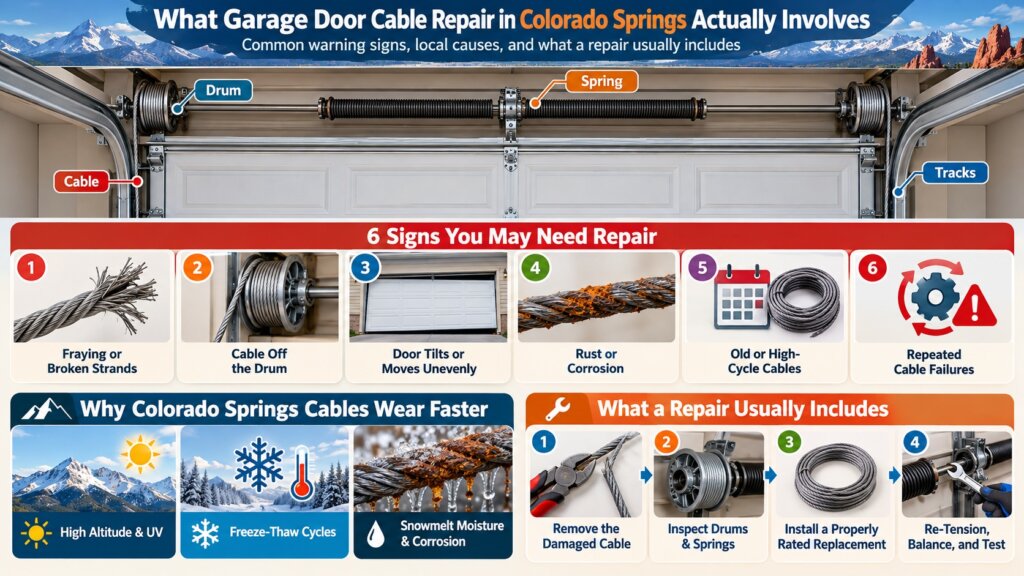
Garage door cables are steel wire ropes that connect the door to the spring system, allowing the door to raise and lower smoothly. They run along the sides of the door, wrap around drums at the top of the tracks, and bear a significant share of the door’s weight during operation. When a cable breaks or wears out, the door can drop unevenly, bind in the tracks, or stop moving entirely.
In Colorado Springs, the combination of high altitude, intense UV exposure, and repeated freeze-thaw cycles puts extra stress on metal components. Cable sheaths can become brittle in cold temperatures, and moisture from snowmelt can accelerate corrosion on uncoated steel cables. These local conditions mean cables here tend to wear faster than in more temperate regions.
Garage door cable repair typically involves removing the old cable, inspecting the drum and spring system for related wear, and installing a replacement cable rated for your door’s weight. A technician will also re-tension and balance the door before testing it through several full cycles.
1. Visible Fraying or Broken Strands
Steel cables are made of multiple twisted wire strands. When even a few of those strands break or fray, the cable’s load capacity drops significantly. You may notice small wire tufts near the drum or along the cable path. This is a clear indicator that the cable needs immediate replacement, not just monitoring.
2. Cable Has Jumped Off the Drum
A cable that has slipped off its drum will cause the door to hang at an angle or refuse to move. This often happens when the spring system loses tension suddenly or when the door is forced open manually. Re-routing and re-tensioning the cable requires releasing spring tension first, which is a high-risk task that demands professional handling.
3. Door Moves Unevenly or Tilts
If one side of your door rises faster than the other, a cable on one side may be slack or broken. Uneven movement puts stress on the tracks, rollers, and opener motor. Left unaddressed, it can damage multiple components at once and increase your total repair cost.
4. Rust or Corrosion on the Cable
Surface rust on a garage door cable is more than cosmetic. Corrosion weakens the individual wire strands and makes the cable prone to sudden failure. In Colorado Springs, garages that experience condensation from temperature swings are especially vulnerable. A corroded cable should be replaced, not cleaned and reused.
5. Cable Age Exceeds Manufacturer Guidelines
Most garage door cables are rated for a specific number of cycles, typically between 10,000 and 20,000 depending on the gauge and coating. If your door has been in service for 10 or more years without a cable inspection, the cables may be near the end of their service life even if they look intact. Proactive replacement during a tune-up can prevent an unexpected failure.
6. Repeated Cable Failures in the Same System
If your cables have needed repair more than once in a short period, the root cause is likely elsewhere in the system. A worn drum, a misaligned spring, or an improperly balanced door can put abnormal stress on cables and cause them to fail prematurely. In this case, replacing the cable alone will not solve the problem.
Understanding what is actually wrong with your cable system is the first step toward choosing the right fix. The next section breaks down when a simple cable repair is sufficient and when a full replacement makes more sense.
Garage Door Cable Repair vs. Replacement: How to Decide
Not every cable problem requires a full replacement. The right call depends on the cable’s condition, the age of the overall system, and whether related components are also showing wear. Here is a straightforward comparison to help you think through the decision.
| Situation | Recommended Action | Typical Reason |
|---|---|---|
| Single cable snapped, system is under 7 years old | Cable repair or single replacement | Isolated failure, rest of system is sound |
| Both cables show fraying or rust | Replace both cables as a set | Matching wear means the second will fail soon |
| Cable failure plus worn drum or spring | Replace cable, drum, and spring together | Root cause must be addressed to prevent repeat failure |
| System is 10+ years old with multiple issues | Full system evaluation, possible full replacement | Cost of piecemeal repairs may exceed replacement value |
| Cable jumped off drum, no visible damage | Re-route and re-tension cable | Mechanical issue, not material failure |
You might be wondering whether replacing both cables at once is worth it even if only one has failed. Industry practice and manufacturer guidance both support replacing cables in pairs. Since both cables operate under the same conditions and accumulate the same number of cycles, the second cable is typically close to the same wear point as the one that failed.
Once you know what type of service your door needs, the next consideration is finding the right professional to do the work safely and correctly.
Why Professional Garage Door Cable Repair in Colorado Springs Is Non-Negotiable
Garage door cables are under extreme tension because they work in tandem with torsion or extension springs. A peer-reviewed case series published in a medical journal documented seven severe eye injuries among people who attempted garage door repairs themselves, specifically citing the stored energy in spring systems as the cause of injury. This is not a task where a DIY approach is advisable.
The U.S. Consumer Product Safety Commission advises homeowners to inspect garage doors and openers regularly, check balance and hardware condition, and have unbalanced or binding doors serviced by a professional. Attempting to release spring tension or re-route cables without proper tools and training puts you at serious risk.
Colorado Springs also requires permits for a range of residential and commercial construction and repair work. If your cable repair involves structural components or is part of a larger garage renovation, checking with the city’s permit office is a responsible step. The City of Colorado Springs Engineering, Inspections, Permitting and Fees page outlines current requirements.
This is where Garage Door Colorado Springs brings clear value. As a locally operated company with experienced technicians, the company handles cable repair and replacement using manufacturer-approved components, follows local building codes, and performs full balance and safety checks on every job. Whether your door is a standard residential model or a light-commercial bay door, the team provides honest, evidence-based recommendations—no upselling, no guesswork.
If you are dealing with a cable issue right now, the safest next step is to keep the door closed and not attempt to operate it until a technician has assessed the system. You can schedule service directly to get a technician on-site quickly.
Local Factors That Affect Garage Door Cable Wear in El Paso County
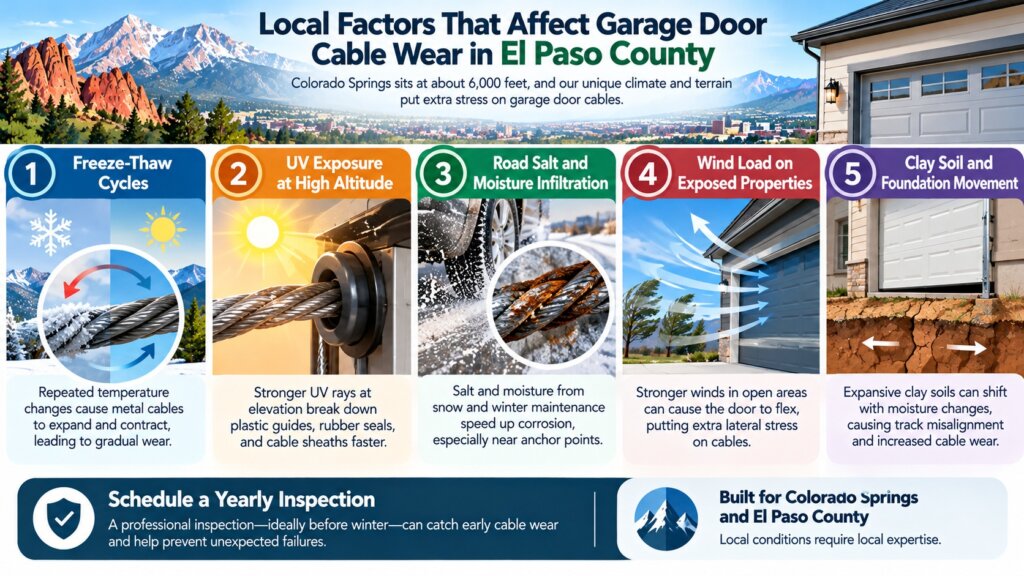
Colorado Springs sits at roughly 6,000 feet above sea level, and the surrounding communities in El Paso County experience some of the most variable weather conditions in the state. These factors directly affect how long your garage door cables last and how often they need inspection.
1. Freeze-Thaw Cycles
Temperatures in Colorado Springs can swing dramatically between day and night, especially in fall and spring. Metal cables expand and contract with these temperature changes. Over time, this repeated movement causes micro-fatigue in the wire strands, even when the cable appears undamaged on the surface.
2. UV Exposure at High Altitude
At elevation, UV radiation is more intense than at sea level. Plastic cable guides, rubber seals around the drum housing, and any polymer-coated cable sheaths degrade faster here. Degraded guides can cause cables to fray against rough edges rather than running cleanly.
3. Road Salt and Moisture Infiltration
During winter, road salt and sand tracked into garages can settle near the base of the door and work their way toward the cable anchor points. Salt accelerates corrosion on steel cables, particularly near the bottom bracket where the cable terminates.
4. Wind Load on Hillside and Exposed Properties
Properties in areas like Manitou Springs, Falcon, or Peyton that face open terrain experience stronger wind loads on garage doors. Wind pressure can cause a door to flex and shift during operation, putting lateral stress on cables that are designed primarily for vertical load.
5. Clay Soil and Foundation Movement
El Paso County has areas with expansive clay soils that shift with moisture changes. Foundation movement can affect the door frame, causing the tracks to go slightly out of alignment. Misaligned tracks force cables to run at angles they were not designed for, increasing wear at the drum and anchor points.
Knowing these local risk factors helps you plan a realistic maintenance schedule. A professional inspection once a year—ideally before winter—gives a technician the opportunity to catch early cable wear before it becomes a failure.
What to Expect From a Professional Cable Repair Service Call
A standard cable repair appointment in Colorado Springs typically follows a clear sequence. Knowing what happens during the visit helps you ask the right questions and understand what you are paying for.
- Visual inspection: The technician examines both cables, the drums, spring system, tracks, and rollers for visible damage or wear.
- Balance test: The door is manually disconnected from the opener and lifted halfway. A properly balanced door should stay in place without assistance. If it drops or rises, the spring tension needs adjustment.
- Spring tension release: Before touching the cables, the technician safely releases spring tension using winding bars or a controlled release method. This step is critical and should never be skipped.
- Cable removal and replacement: The old cable is removed from the drum and bottom bracket. The new cable is threaded through the same path and secured at both anchor points.
- Drum re-winding: The cable is wound onto the drum with the correct number of turns to match the spring tension and door weight.
- Re-tensioning and balance recheck: Spring tension is restored and the balance test is repeated. The door should move smoothly and hold at the halfway point.
- Full cycle test: The technician runs the door through several complete open-and-close cycles, checking for smooth travel, proper auto-reverse function, and correct limit settings on the opener.
A complete cable replacement on a standard residential door typically takes one to two hours. If the drums or springs also need service, the appointment may run longer. A reputable technician will walk you through the findings before beginning work and give you a clear cost estimate upfront.
For homeowners across Colorado Springs, Fountain, Monument, and Woodland Park who want a full system check along with their cable service, Garage Door Colorado Springs offers preventive tune-ups that cover cable condition, spring balance, roller wear, track alignment, and safety sensor testing in a single visit. Book a Safety Tune-Up to keep your door running reliably through every season.
Conclusion
Garage door cable repair in Colorado Springs is a safety-critical service that depends on accurate diagnosis, the right parts, and proper spring-tension management—all of which require trained hands and proper tools. Whether you are dealing with a snapped cable, visible fraying, or a door that moves unevenly, the decision between repair and replacement comes down to the cable’s condition, the system’s age, and whether related components are also worn. Garage Door Colorado Springs provides honest, code-compliant cable repair and full system evaluations for homes and light-commercial properties across the Pikes Peak region. Schedule your service call today and get your door operating safely again.
Garage Door Colorado Springs specializes in cable and spring replacement using durable, code-compliant components. Our experienced technicians diagnose worn cables accurately and recommend only what your door truly needs. Call us today to schedule an honest assessment—get started now.
FAQs
How Much Does It Cost to Repair a Garage Door Cable in Colorado Springs?
Most cable repairs or replacements in Colorado Springs typically range from about $150–$350, depending on the door size/weight, whether one or both cables are replaced, and if related parts (springs, drums, rollers, or track alignment) also need service. A proper quote should include a safety inspection and door balance check, which our technicians perform to prevent repeat failures.
Can I Replace a Garage Door Cable Myself?
It’s not recommended. Garage door cables work under high spring tension, and mistakes can cause serious injury or further damage. Professional service ensures the correct cable type, proper winding/tensioning, alignment, and code-compliant safety checks.
What Causes Garage Door Cables to Snap or Come Off?
Common causes include worn or frayed cables, rust/corrosion, misaligned tracks, damaged drums, loose hardware, worn rollers, and improper spring tension or an unbalanced door. Cables can also come off if a door is forced while stuck, or if a spring breaks and the lift system loses even tension.
How Long Does It Take to Repair or Replace Garage Door Cables?
In many cases, cable replacement takes about 45–90 minutes, assuming no major additional issues. If springs, drums, or track alignment also need correction, the visit may take longer to complete safely and restore smooth operation.
Is It Safe to Use a Garage Door if the Cable Is Broken or Off Track?
No. Stop using the door and avoid running the opener, as the door can jam, fall, or twist and cause injury or damage. It’s best to keep the door closed if possible and schedule a repair so the lift system can be restored and safety-tested.
