
Your garage door works because of one critical component: the torsion spring. This tightly wound steel spring sits above the door and stores mechanical energy to counterbalance the door’s weight, making it possible to lift and lower hundreds of pounds with minimal effort. When that spring fails, your door can become dangerous, unpredictable, or completely inoperable.
This guide explains exactly when torsion spring repair is necessary in Colorado Springs, what warning signs to watch for, and why professional service is the only safe path forward. You will also learn how Colorado’s unique climate affects spring performance and what your repair options look like in terms of cost, timing, and longevity.
Key Takeaways
- A broken or unbalanced torsion spring can cause a garage door to fall rapidly, creating a serious struck-by hazard.
- OSHA identifies stored energy in torsion springs as a workplace hazard that requires safe discharge before any maintenance.
- Colorado Springs freeze-thaw cycles and UV exposure accelerate spring wear beyond average national timelines.
- Common signs of spring failure include a door that stops halfway, uneven lifting, loud bangs, or visible gaps in the spring coil.
- Torsion spring repair should always be performed by a qualified technician, never attempted as a DIY project.
- Repair versus replacement depends on spring age, door weight, cycle count, and the condition of related hardware.
Understanding the basics of how torsion springs work puts you in a much better position to recognize problems early. Let’s start with the most direct answer to the question homeowners ask most often.
When Torsion Spring Repair in Colorado Springs Becomes Necessary
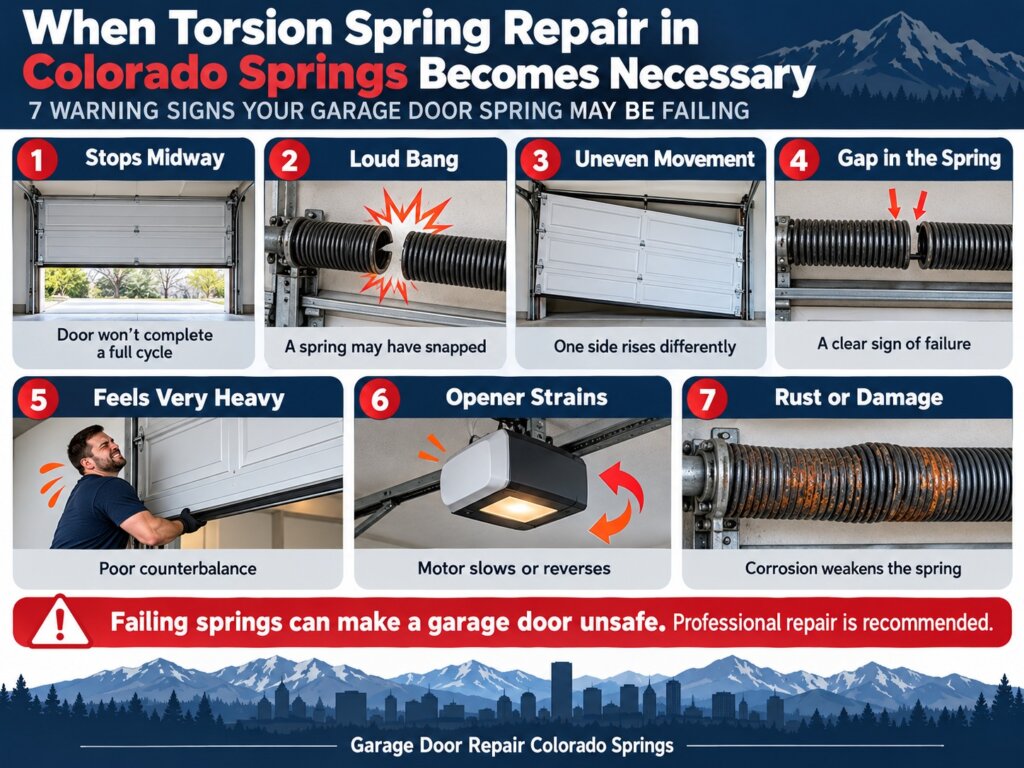
Torsion spring repair becomes necessary the moment your garage door stops operating safely or smoothly. A spring that is worn, cracked, or broken cannot support the door’s full weight, which means the opener motor carries an unintended load and the door becomes unpredictable. Federal product-safety guidance from the U.S. government states that weak or broken springs may allow a garage door to fall rapidly, and recommends that qualified service personnel handle all spring assembly repairs.
In Colorado Springs specifically, springs face stress beyond the national average. Temperatures can swing 40 degrees in a single day during spring and fall, and the region’s high altitude means metal components experience more UV exposure and faster oxidation. These conditions compress a spring’s useful life, meaning a spring rated for 10,000 cycles in a moderate climate may show fatigue signs earlier here.
You might be wondering how to tell the difference between a door that needs a tune-up and one with a genuinely failing spring. The distinction matters because the repair approach and urgency are different.
1. The Door Stops Moving Midway
If your garage door opens a few feet and then stops, the spring may no longer have enough stored energy to carry the door through a full cycle. This is one of the earliest mechanical signs of spring fatigue. Do not force the door manually or override the opener in this situation.
2. You Hear a Loud Bang From the Garage
A sudden, sharp bang from inside the garage, especially when the door is closed, often means a torsion spring has snapped under tension. The New York State Department of Health’s Fatality Assessment and Control Evaluation program documented that overhead-door springs can cause serious physical injury or death when they release stored energy without warning. If you hear this sound, treat the door as inoperable until a technician inspects it.
3. The Door Looks Uneven When It Moves
A door that tilts to one side during operation suggests one spring is weaker than the other. Many residential doors use a two-spring system, and when one loses tension faster than the other, the imbalance puts stress on cables, rollers, and tracks. Left unaddressed, this can lead to cable fraying or track damage that adds to your repair cost.
4. You See a Visible Gap in the Spring Coil
A broken torsion spring often shows a clear separation between coils, visible as a gap along the spring shaft above the door. This is a definitive sign that the spring has failed and the door should not be operated until the spring is replaced.
5. The Door Feels Extremely Heavy When Lifted Manually
Disconnect the opener and try lifting the door manually from the bottom. A properly balanced door should rise smoothly and stay in place at about waist height with minimal effort. If the door feels very heavy or drops immediately, the spring is not providing adequate counterbalance.
6. The Opener Strains or Reverses Unexpectedly
Modern garage door openers include torque limits that cause the motor to stop or reverse when resistance exceeds a set threshold. If your opener strains, slows, or reverses on a door that used to operate normally, the spring system may be losing tension and placing excess load on the motor.
7. The Spring Shows Rust, Corrosion, or Deformation
Visual rust on the coils is a sign that the spring’s tensile strength is compromised. Colorado’s clay soils and seasonal moisture contribute to corrosion on metal components, particularly in homes with poor garage ventilation. A corroded spring is more likely to snap without warning than a clean one.
Now that you know the signs, the next logical question is what the repair process looks like and why it carries specific risks that make professional handling non-negotiable.
Why Torsion Spring Repair in Colorado Springs Requires a Professional Technician
Torsion springs store a significant amount of mechanical energy when wound, and that energy does not disappear when the spring breaks. OSHA identifies unbalanced potential energy in garage-door torsion springs as a struck-by hazard and states that springs should be fully unwound to remove stored energy before any maintenance, repair, or alteration of the counterbalance system. This is not a precaution that can be skipped or approximated.
The CDC reinforces this position, recommending that stored mechanical energy in spring-loaded mechanisms be safely discharged or contained before any servicing begins. A peer-reviewed study indexed by the National Institutes of Health also documented eye injuries associated with attempts to repair garage-door springs at home, noting that misdirected stored energy can cause severe trauma.
These are not rare edge cases. They reflect the consistent finding across safety agencies that torsion spring repair carries real injury risk for anyone without the proper tools, training, and containment equipment.
Garage Door Colorado Springs sends trained technicians who follow manufacturer specifications and local building codes on every spring job. The team uses calibrated winding bars, torque measurements, and balance checks to ensure the repaired spring system performs safely across the door’s full cycle range. If you need a broken spring replaced or a worn spring assessed before it fails, schedule a service appointment and get a same-day or next-day visit from a qualified technician.
Torsion Spring Repair vs. Replacement in Colorado Springs: How to Decide
Not every spring problem requires a full replacement, but not every problem can be resolved with a simple adjustment either. The decision depends on several factors that a technician will assess during the inspection.
| Situation | Recommended Action | Typical Timeline |
|---|---|---|
| Spring is broken or has visible gap | Full replacement required | Same day in most cases |
| Spring is intact but door is unbalanced | Tension adjustment and balance test | 1–2 hours |
| Spring shows rust or corrosion | Replacement recommended before failure | Same day or scheduled |
| Spring is near end of cycle life | Proactive replacement with higher-cycle spring | Scheduled appointment |
| One spring broken on a two-spring system | Replace both springs simultaneously | Same day in most cases |
Replacing both springs at the same time on a dual-spring system is a standard industry practice. When one spring breaks, the other is typically at a similar point in its cycle life. Replacing only the broken spring often means a return visit within weeks or months when the second one fails.
Choosing a higher-cycle spring, such as a 25,000-cycle spring instead of a standard 10,000-cycle unit, costs more upfront but extends the interval between replacements. For Colorado Springs homeowners who use their garage as a primary entry point, this upgrade often pays for itself in reduced service calls.
How Colorado Springs Climate Affects Torsion Spring Repair Timing
Colorado Springs sits at roughly 6,000 feet above sea level, and that elevation brings conditions that directly affect how long torsion springs last. The freeze-thaw cycles that occur through fall, winter, and early spring cause metal to contract and expand repeatedly, which accelerates fatigue in coil springs. A spring that might last seven to nine years in a temperate climate may need attention in five to seven years here.
UV exposure at altitude also degrades lubricants faster than at lower elevations. Torsion springs rely on regular lubrication to reduce friction and heat buildup during cycling. When the lubricant breaks down, the spring coils generate more heat during operation, which shortens coil life. Applying a garage-door-specific lubricant, not WD-40, twice a year is one of the most effective ways to extend spring life between professional service visits.
Wind is another factor. Homes on hillside drives around Manitou Springs or in exposed areas near Falcon and Peyton experience higher wind loads on garage doors, which means the door opens and closes with more resistance. That resistance translates directly to additional strain on the spring system over time.
A preventive tune-up from Garage Door Colorado Springs includes a full spring inspection, lubrication, balance test, and hardware check calibrated to Colorado conditions. Book a safety tune-up before winter sets in to catch wear before it becomes an emergency repair.
What to Expect During a Professional Torsion Spring Repair in Colorado Springs
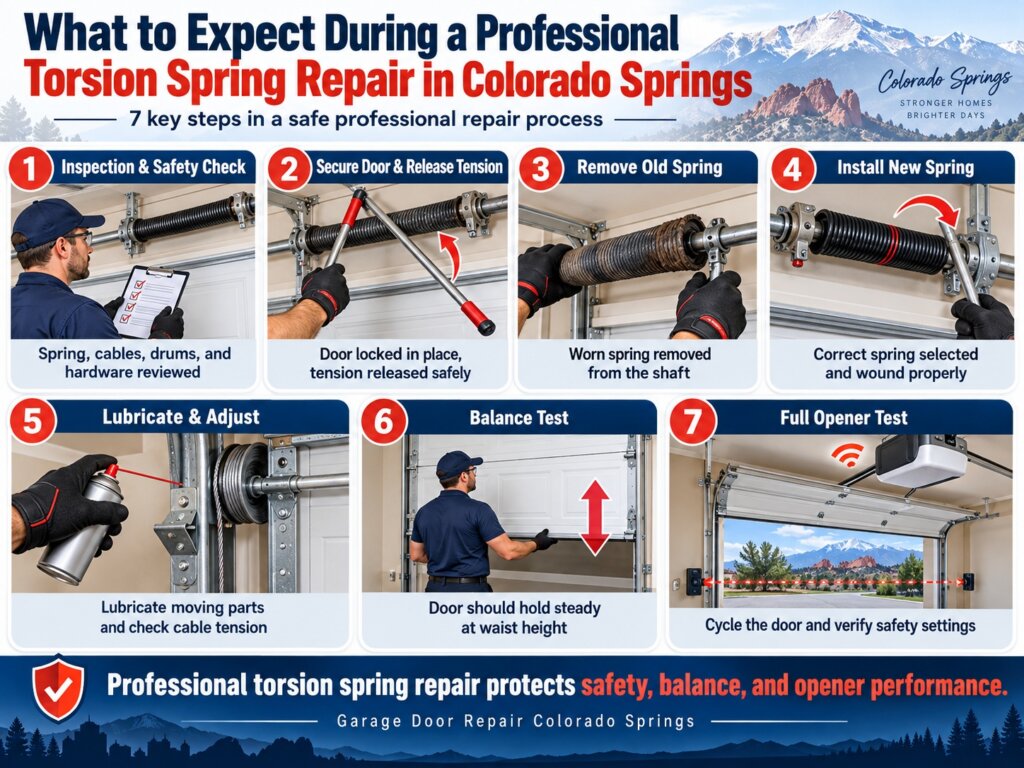
Knowing what happens during a professional spring repair helps you prepare and ask the right questions. A qualified technician follows a structured process to ensure the repair is safe and the door operates correctly after the job is done.
1. Initial Inspection and Safety Assessment
The technician examines the spring, cable, drum, and hardware condition before touching any component. This step identifies related issues that could affect the repair outcome.
2. Securing the Door and Releasing Tension Safely
The door is secured in place and the existing spring tension is released using calibrated winding bars. This step addresses the stored-energy hazard that OSHA and the CDC identify as the primary injury risk in spring service.
3. Removing the Old Spring
The worn or broken spring is removed from the torsion shaft. The technician inspects the shaft, center bearing, and end cones for wear or damage before installing the new component.
4. Installing the Replacement Spring
The new spring is selected based on door weight, height, and the number of cycles required. It is installed and wound to the manufacturer-specified tension for that door configuration.
5. Lubricating and Adjusting the System
The spring, cables, rollers, and hinges receive lubrication. Cable tension is checked and adjusted to ensure even lift on both sides of the door.
6. Balance Test
The technician disconnects the opener and manually lifts the door to waist height. A properly balanced door stays in place without drifting up or down. This test confirms the spring tension is correct.
7. Full Operational Test With the Opener
The opener is reconnected and the door cycles several times. The technician checks opener force settings, reversal sensitivity, and safety sensor alignment before completing the job.
Conclusion
Torsion spring repair in Colorado Springs is necessary when your door shows signs of imbalance, fails to complete a full cycle, produces a sudden loud noise, or when a visual inspection reveals a broken or corroded coil. Because torsion springs store significant mechanical energy, repair work carries real injury risk and should always be handled by a trained professional with the right tools and safety procedures. Garage Door Colorado Springs provides same-day spring replacement, full balance testing, and preventive inspections across El Paso County, Manitou Springs, Monument, Fountain, Falcon, Peyton, and Woodland Park, so your door operates safely through every Colorado season. Schedule your service today and get a technician on-site fast.
Garage Door Colorado Springs specializes in expert torsion spring replacement and balancing for homes across El Paso County. Our certified technicians diagnose worn or broken springs fast, restoring safe, smooth operation every time. Call us today to get started with an honest, tailored repair estimate.
FAQs
How Much Does It Cost to Replace a Torsion Spring in Colorado Springs?
Most torsion spring replacements in Colorado Springs typically range from about $200–$500+, depending on door size/weight, single vs. dual springs, cycle rating (standard vs. high-cycle), and whether additional parts (cables, bearings, rollers) are worn. A proper quote should include correct spring sizing, balancing, and a full safety check.
How Long Does a Garage Door Torsion Spring Repair Take?
In many cases, replacing torsion springs and balancing the door takes about 60–120 minutes. Time can increase if there’s damage to cables, drums, end bearings, or the door is out of alignment and needs additional adjustments.
Can I Replace a Torsion Spring Myself or Should I Hire a Professional?
It’s strongly recommended to hire a professional. Torsion springs are under high tension and can cause serious injury or property damage if handled incorrectly. A trained technician uses proper winding tools, verifies spring sizing, balances the door to manufacturer specs, and confirms safety systems are working.
How Do I Know If My Garage Door Torsion Spring Is Broken?
Common signs include a loud bang from the garage, the door only lifting a few inches or not at all, a visibly separated spring (gap in the coil), a crooked door, slack cables, or an opener that strains and stops. If you suspect a break, stop using the door and schedule an inspection.
How Many Cycles Do Torsion Springs Last and When Should They Be Replaced?
Many standard torsion springs are rated around 10,000 cycles (one open/close = one cycle), while high-cycle options can be 20,000+ cycles. Replace springs when one breaks, when the door becomes heavy or unbalanced, or when springs show wear/corrosion; many homeowners choose to replace both springs at the same time for reliability and even lifting.
